Error, Bug, Defect, Failure and Incident: Finally Explained | QA Fundamentals #3
26 October 2026
Ask five QA engineers what the difference is between a bug and a defect, and you’ll likely get five different answers. Ask them where a failure ends and an incident begins, and the answers get even less clear.
That isn’t just a vocabulary problem. When a team uses these words loosely, bug reports get misclassified, defect metrics stop meaning anything, root cause analysis looks in the wrong place, and interview answers sound memorized instead of understood.
This article covers all five terms: what each one means, how they connect, where people get them wrong, and how to use them in real QA work.
The chain in one line
Before the details, here’s the overall picture:
A person makes an error → the error leaves a defect (also called a bug) in a work product → the defect is triggered at runtime and causes a failure → a failure in production that affects users or the business becomes an incident.
Each term describes a different stage of the same problem. Once you see it as a chain, the definitions are easy to remember.
1. Error: where it starts
An error is a human mistake. It happens in someone’s thinking or in their work before it shows up anywhere else.
Some examples:
A developer misreads a requirement.
A business analyst leaves out an edge case.
An architect assumes a downstream service will always respond in time.
A tester writes the wrong expected result in a test case.
You can’t test for an error directly, because it happens inside someone’s head. What you can find is what it leaves behind.
Why it matters to QA: When you do root cause analysis, you’re looking for the error. “The code had a wrong condition” describes the defect. “The developer misread an ambiguous requirement” describes the error, and that’s the part that tells you what process needs to change.
2. Defect: what the error leaves behind
A defect is a flaw in a work product that can stop it from doing what it’s supposed to do. It’s what the error produces.
Many people miss that defects aren’t limited to code. They can be found in:
Requirements: missing, ambiguous, or contradictory rules
Design: wrong assumptions about scale, flow, or integration
Code: wrong logic, wrong conditions, unhandled exceptions
Configuration: wrong values, missing feature flags, incorrect environment settings
Test assets: wrong expected results, outdated assertions, broken locators
A defect is static. It sits in the product and does nothing until something triggers it.
Why it matters to QA: The earlier you find a defect, the cheaper it is to fix. A defect found during a requirement review costs one conversation. The same defect found in production can cost a hotfix, refunds, and customer trust. That’s why reviews and static testing count as testing too.
3. Bug: the word everyone uses
So where does bug fit in?
In standard terminology, including ISTQB, bug, defect, and fault are synonyms. They all mean a flaw in a work product.
In practice, teams often draw their own lines:
Some use bug for coding problems found during testing and defect for any deviation from requirements, including requirements and design problems.
Some separate them by timing: problems caught before release are bugs, and problems that escape to customers are defects.
Some use defect as the formal term in trackers and reports and bug as everyday shorthand.
None of these is wrong, but they can’t all apply at once in the same team.
What to do in practice:
Learn your team’s definitions. If your tracker has separate issue types such as Bug, Defect, and Improvement, find out what each one means for your project.
Classify consistently. Choosing the wrong type distorts metrics like defect leakage, escape rate, and defect density. Leadership decisions get made from those numbers.
Don’t argue about the label. A developer cares much more about whether your report is clear, reproducible, and shows the impact than about what you called it.
4. Failure: what users see
A failure happens when the system doesn’t behave as expected while it’s running.
If a defect is static, a failure is dynamic. It only happens when the faulty code runs under the conditions that trigger the flaw.
Take a payment function with a wrong rounding rule. That rule is a defect. If no transaction ever hits that rounding case, nobody sees a problem. When one does, the customer is charged the wrong amount, and that’s the failure.
There are three points here that many QA engineers miss:
A defect doesn’t always cause a failure. If a code path never runs, its defects stay hidden. This is why coverage matters. Tests that never reach a piece of code can’t show what’s wrong with it. It’s also why a product can run for years before a rare input finally exposes a long-standing defect.
A failure doesn’t always come from a product defect. Environment instability, network problems, hardware faults, bad test data, expired certificates, and misconfigured deployments can all cause failures while the code itself is correct. This is why you should reproduce and isolate a failure before you log it as a product defect.
Your test can be the defect. A failing automated test doesn’t automatically mean the product is broken. The script might have a bad locator, an outdated assertion, a timing problem, or a hardcoded value. Experienced automation engineers check their own test first before they blame the application.
A useful way to frame it: testing reveals failures, and debugging finds the defect behind them. They’re separate activities, often done by different people, and mixing them up creates confusion in triage.
5. Incident: when the business feels it
An incident is an unplanned event that disrupts or degrades a live service and needs a managed response.
Not every failure becomes an incident. It depends on where the failure happens and how much it affects users or the business.
A failure in a test environment is a finding. You log it, someone triages it, and it gets fixed.
A failure in production that blocks users, corrupts data, breaches an SLA, or creates a security risk is an incident. It gets a severity level, an owner, a response timeline, and often a war room.
Teams typically declare an incident when:
Users can’t complete a core journey such as login, checkout, payment, or booking
Data is lost, corrupted, or exposed
Performance drops below agreed thresholds
A downstream system, partner, or customer integration is affected
Error rates or monitoring alerts cross a defined threshold
A note on terminology: older ISTQB material used “incident” for any unexpected event during testing that needed investigation, and “incident report” was close to what we now call a bug report. Most of the industry now follows ITIL and SRE practice, where an incident means a problem affecting a live service. If you see the older usage in a certification syllabus or an old process document, that’s the reason.
Why it matters to QA: Incidents are where software quality becomes visible to the business. Strong QA engineers read incident reports and postmortems, ask which test should have caught the problem, and close that gap so it doesn’t happen again.
One problem, start to finish
Here’s the full chain using one realistic example.
The requirement: Orders of ₹1,000 or more get a 10% discount.
Error: The developer reads it as “more than ₹1,000.” It’s a small misunderstanding, and nobody notices.
Defect: The code says: if (total > 1000) applyDiscount(0.10);
It should say: if (total >= 1000) applyDiscount(0.10);
The flaw is now in the codebase and nobody has seen it yet.
Failure: A customer places an order for exactly ₹1,000 and gets no discount. The system has behaved incorrectly at runtime.
Incident: During a festive sale, the marketing team promotes a “₹1,000 combo” and it becomes the best-selling offer. Thousands of customers are charged full price. Support tickets spike, complaints spread on social media, and the business declares a Sev-2 incident. Engineering ships a hotfix and finance starts processing refunds.
One misread word ended up costing money and customer trust.
Where QA could have stopped it
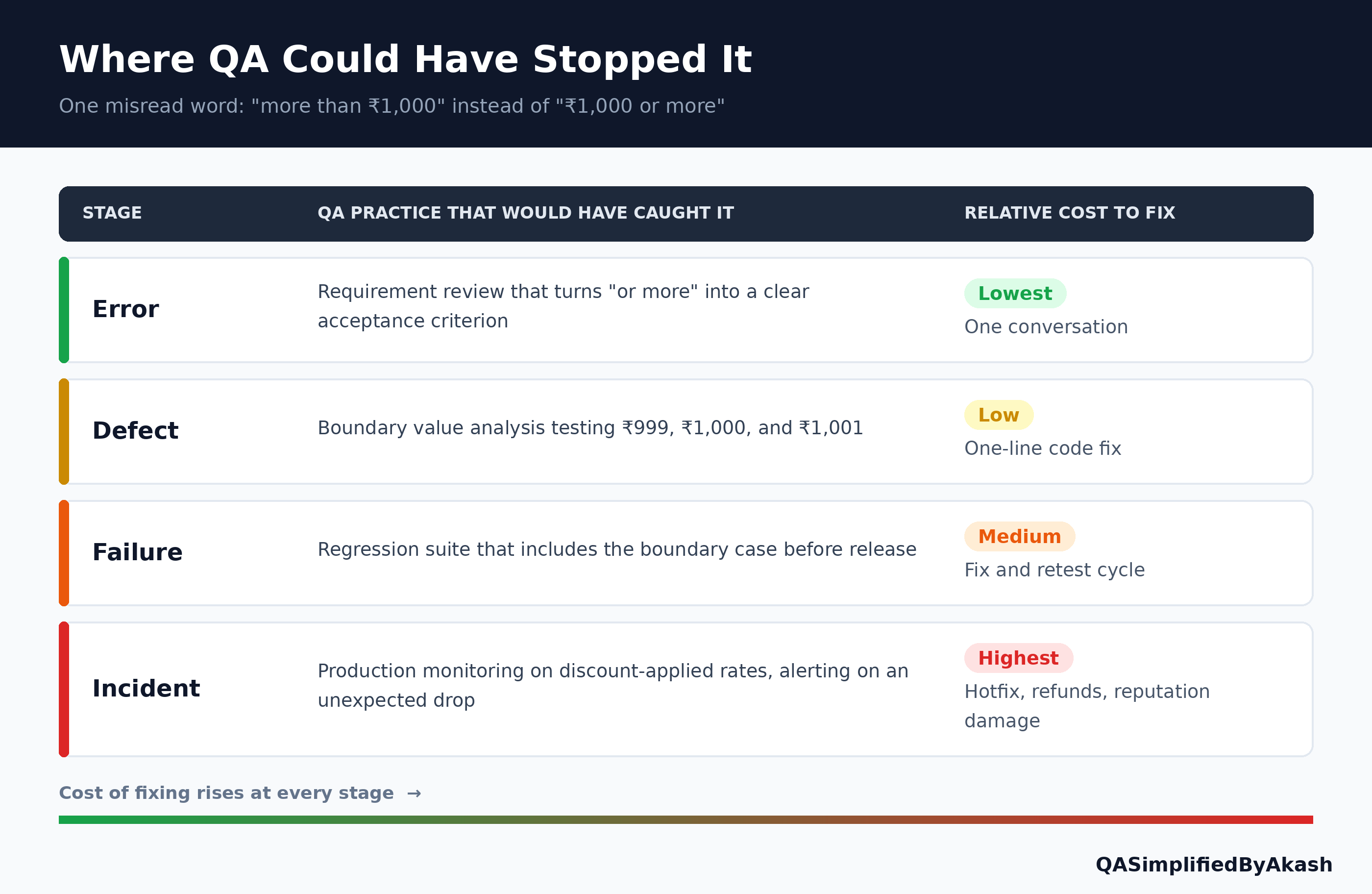
Every stage gives you a chance to stop the problem, and each later stage costs more. Good QA tries to catch problems as close to the original error as possible.
Common mistakes QA engineers make with these terms
Treating every failed test as a product defect. Check the environment, the data, and the test script first.
Assuming defects only exist in code. Some of the most expensive defects are in requirements.
Calling every production issue an incident. A cosmetic issue in production is a defect that escaped. It isn’t automatically an incident unless it affects the service.
Writing “root cause: code bug” in RCA. That describes the defect. The real root cause is the error and the process gap that allowed it.
Arguing over labels during triage. Classify according to your team’s rules and spend the time on reproduction steps and impact.
How to use this in daily QA work
When writing a bug report: describe the failure you saw (expected vs actual), give the conditions that trigger it, and if you’ve isolated it, point to the likely defect location. Don’t guess at the error.
When triaging a failed automation run: ask in order whether it’s the environment, the data, the test, or the product. Only the last one is a product defect.
When contributing to an RCA or postmortem: follow the chain backwards from incident to failure to defect to error. Then ask at which stage a test, review, or monitor could have caught it, and add that safeguard.
When reviewing requirements: remember that you’re looking for defects before they reach the code. Ambiguous words like “more than,” “up to,” “within,” and “approximately” are where boundary defects usually come from.
Interview questions you should be ready for
1. What is the difference between an error, a defect, and a failure? An error is a human mistake. A defect is the flaw that mistake leaves in a work product. A failure is the incorrect behavior you observe when the defect is triggered at runtime.
2. Are bug and defect the same? In standard terminology such as ISTQB, yes, they’re synonyms. Some organizations separate them by type or timing, for example bugs found before release and defects that escape to customers, so it’s worth following the convention your team uses.
3. Can a defect exist without causing a failure? Yes. If the faulty code path never runs, or the triggering conditions never happen, the defect stays hidden. This is why test coverage and boundary testing matter.
4. Can a failure happen without a defect in the product? Yes. Environment problems, network faults, bad test data, or misconfiguration can cause failures while the code is correct. A faulty test script can also produce a false failure.
5. When does a failure become an incident? When it happens in a live service and affects users, data, SLAs, security, or business operations enough to need a managed response with severity, ownership, and resolution tracking.
6. Can defects exist in documents, not just code? Yes. Requirements, designs, test cases, and configurations can all contain defects. Finding them through reviews is usually the cheapest way to prevent failures.
7. Walk me through how a small mistake becomes a production incident. Use a boundary example like the ₹1,000 discount. Show each stage and explain which QA practice could have stopped it at each point. Interviewers usually value this answer more than a memorized definition.
8. In RCA, why isn’t “code bug” an acceptable root cause? Because it only names the defect. A useful root cause identifies the error and the process gap behind it, such as an ambiguous requirement, a missing review, or no boundary tests, so the team can stop it from happening again.
Final thought
These five words describe the stages of a single problem. An error starts it, a defect carries it, a failure exposes it, and an incident is the point where users and the business feel it.
A QA engineer who understands this chain does more than find bugs. They know where a problem started, where it could have been caught, and what to change so it doesn’t happen again.
Share this article
Found this useful? Share it with another QA engineer.
Keep learning